BROADWAY LIGHTS GO DARK FOR MINSTREL WHO WORE TWO FACES
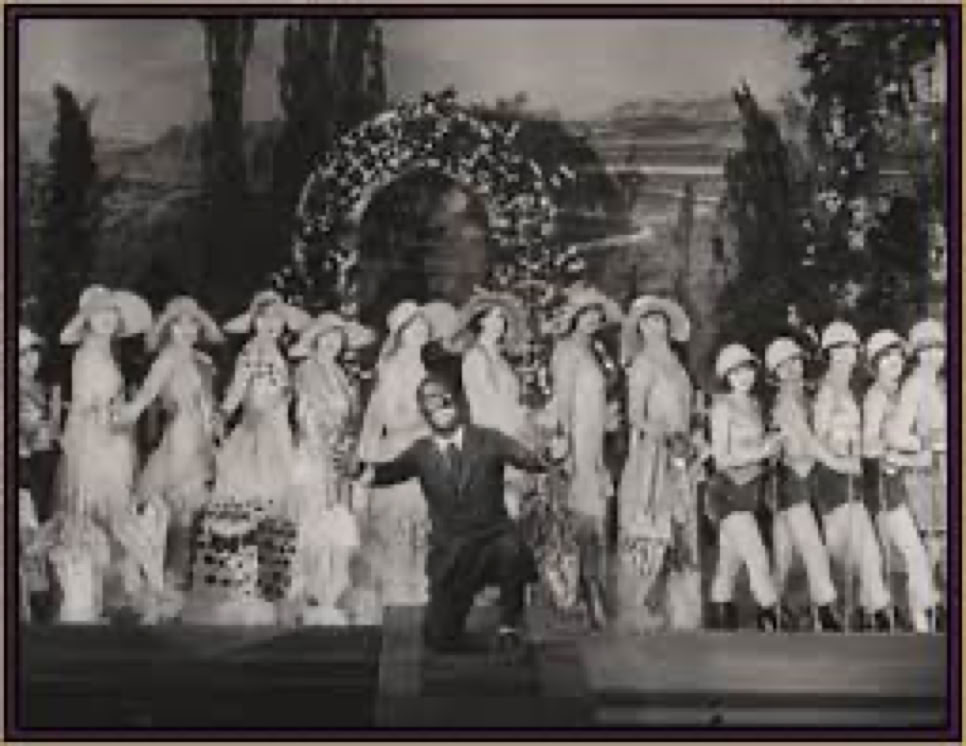
ON THE DAY of his death the lights went out on Broadway for the man the Press called: “The World’s Greatest Entertainer.” He was the man who hid behind a false black face, Al Jolson.
So great was his following that he was the highest earning stage performer for nearly 40 years and even newspaper critics sometimes struggled with words to adequately convey his stage impact.
The little minstrel from the shores of the Potomac River, brought tears to his audience singing My Mammy, Swanee and When I Leave the World,
“He has the seal of genuine magnetism in his fingertips,” said the Chicago Daily News. “He is tingling with theatre, music and poetry, and a sense of gentle emotions …”
Not so gentle, it turned out. For some newspapers would soon carry another story. Behind the mask he had a reputation of being difficult to handle; sometimes wild. His first wife Henrietta divorced him in 1918 after being beaten up as he drifted from one affair to another. He beat up his second wife Alma Osbourne as well and she divorced him in 1928.
He had a reputation for being petty with other performers, sometimes having them fired if they seemed more popular than him. He was an obsessive gambler and a self-proclaimed egomaniac who allegedly forced his name onto songs he didn’t write to claim royalties.
One story did the rounds of the Press that he tried to sexually assault actress Barbara Stanwyck and tortured her with a cigar when she resisted. He went on to have two more wives.
Gambling was his love right up to the night he died after playing cards in a San Francisco hotel on October 2, 1950, aged 64.
He had just returned from entertaining troops in Korea, and he was exhausted. In the archives I came across a revealing letter from a surgeon who was called to the hotel that fatal night, Mr William Warford, of the city’s University Hospital.
He wrote: “During the evening, one of Al’s pals rang to ask me to come and see him at once. I told him to get Al’s own physician, but Al himself interrupted, and I could tell from his voice that he was in great distress.
“I arrived at the hotel at 10.20pm. By this time the distressing pressure pain that Al had suffered beneath his breastbone had subsided and he was in bed. Al at once started to relate his symptoms to me which had started soon after a hearty supper at the Fisherman’s Wharf.
“They subsided then returned when he got back to the hotel and was playing gin rummy. Again, they subsided and he went to bed. As I listened, he went on to tell of his recent trip to Korea where he entertained the troops and had a long talk with General MacArthur.
“He seemed full of vigour, was a good colour and in no distress. With gusto he said he had longer with MacArthur than President Truman did recently. The whole episode lasted just a few minutes, but Al put everything into it, all his energy, despite us urging him to rest.
“Then he paused momentarily and put his head back on the pillow. His eyes rolled upwards and he said: ‘Well boys, this is the end!’” It was. A moment later Al Jolson died.
More than 20,000 people gathered in the streets for his funeral at Temple Israel in Hollywood on October 26, 1950. The crowd was so large there was fighting in places, and the service had to be delayed. Inside was a fame club of the rich and powerful from Senators to Jack Benny, George Burns, Bing Crosby, Bob Hope, and Groucho Marx.
Johnson was born Asa Yoelson in the village of Seredžius, Lithuania, to Moses and Nechama Yoelson. His father was a strict rabbi and director of church music who moved the family to Washington, D.C., to escape poverty.
His mother died in 1895 when he was only eight, a loss that profoundly impacted him and influenced his signature sentimental singing style, particularly the song My Mammy.
After burlesque and vaudeville at 19 he changed his name to Harry Jolson and began to wear ‘burnt cork’ make-up, to stain his face black, a hold-over from the many minstrel shows of the 19th century. He did it to enhance his performances and bring more emotion to his songs as another person.
His womanising was largely absent from the biographical films of his life, such as The Jolson Story, which presented a sort of sanitised, Hollywood ‘singing monk’ image of the star. And of course, he was always a mummy’s boy.
REPORTER POLLY AT HIGH POINT OF HER CAREER
HERE’S a woman reporter who would go to any lengths to get her story. Newshound Polly, played by actress Polly Moore in one of the last Silent Films, The Thirteenth Hour in 1927.
Female reporters were called ‘sob sisters’ in the film industry at this time because their jobs mostly involved covering emotional stories like interviewing a distraught wife whose husband has been murdered or victims of accidents.
But as she dangles on a ladder high over the traffic while investigating a haunted house and a master burglar, Polly apparently paved the way for bigger roles for Lady Hacks in the movies, dominated by women script writers at this time.
NIGHT OUT WITH BANKSY, HIS LADDER AND A SACK OF PAINT,
ENDS IN A BRISTOL BLUES BAR
BY THE year 2,000 art activist Banksy had been causing a stir in the establishment. His graffiti work was gaining fame, not just among the young but Britain’s underground network of society rebels of all ages too.
Banksy was so secretive the public knew little about him but one journalist got close to him at this time, so much so, that he even held his ladder while the artist’s works of art were being sprayed across the walls of Bristol.
His name was Si Mitchell and his feature for the radical magazine Squall, (a publication no longer with us), is a revealing insight to Banksy the man.
The magazine was independent of any lobby group, political party, company or commercial intention and didn’t take ads.
Here are some of the anecdotal gems Si brought to us on July 5, 2,000, when he went out for a night with the elusive but prolific wall painter 24 years before his work on the ‘Animal Art Trail’ at London Zoo, which included a gorilla lifting shutters to release a sea lion and birds, symbolising freedom.
Si writes: “It’s the middle of a starry Sunday night, and Britain’s most maverick artist Banksy, is up a ladder in downtown Bristol. And I am on the bottom rung.
“A 10-foot monkey has leapt from the spray can in his hand and has started to trash an insidious looking CCTV camera.
“Whilst I’m standing at the base of the ladder Banksy’s recalling his last bit of natural history graffiti work, in Regent Park Penguin enclosure just a few days earlier.
“Banksy takes up the story:
‘It was deathly quiet in the zoo at 3am. Then the penguins all started jumping in the water. I’m going: Shh... for fucks sake. And they’re splashing about, making a right racket.
‘I’m writing things, that I assume a penguin would write if it was writing graffiti, right close to the floor. About a dozen of them all got out of the water and start edging towards me in a little gang making this ‘aaaaarr’, Mars Attacks sort of noise.’
“Banksy told how he left the words: ‘We’re bored with fish!’ on the wall.’ And: ‘Laugh now, but one day we’ll be in charge!’
“Banksy said he got into drawing when asked to do a flyer, and from there into graffiti. ‘Spray paint’s actually quite hard to use, and I found myself painting embarrassingly bad pictures, illegally on a wall, at 21 years old’, he says. ‘That’s not acceptable.’
“He paused while a police car idled at some lights not 15-feet from where we’re painting. A van partially conceals us, some of the monkey and the huge sack of paint cans.
“Banksy says; ‘Fifteen years ago there weren’t 24-hour supermarkets and boozers open round the clock. You could paint for 40 minutes on a main road without a car going past. Now you’re lucky to get 50 seconds.’
“To overcome both his own incompetence and the need to work fast, Banksy began using stencils. From the ‘Heavy Weaponry’ missile-bearing elephant, to the little boy ominously nursing a sickle behind his back, as a policeman bends to talk to him, the works are a crowd puller.
“Despite the infamy he’s created, Banksy dismisses accusations about being any real threat to the state. ‘It’s only a bit of painting and decorating,’ he says. ‘But I got politicised during the poll tax, and the Hartcliffe Riots - that was Bristol’s Rodney King, sparked by the death of two local lads whose motorcycle was chased into a wall by the police.
‘I can remember my old man taking me down to see the Lloyds bank - what was left of it - after the 1980 St Pauls riots.’
“By now, we’ve stopped walking and are standing on a corner, outside Bristol’s Central Police Station. ‘Now the police,’ says Banksy whipping a stencil out of his bag. ‘They are the bane of my profession. I have to think about the old bill all the time.’
“ He gaffer tapes the cardboard to the station wall and proceeds to spray on a stencil of two running officers. ‘So much about my images is governed by the police: where I put them, how quickly I can slap them up. But maybe it gives them an edge they wouldn’t otherwise have.’
“He finishes the stencil and draws in a chunky little stick man hot footing it from the cops. The plan was to paint the same stencil flipped round 20 yards down the street, with a bunch of tooled up stick men chasing the cops back, but two policemen choose that moment to bundle out of the main doors.
“‘I’ve never actually been nicked for graffiti,’ Banksy admits half an hour later, over a beer in a St Pauls blues bar. ‘But we’ve had some scrapes.
“‘I just want to make one fucking great image that goes out real cheap to every mothafucker!’”
MAGAZINE WAS A GOLD MINE OF VICTORIAN TALENT
THE ONE publication from the past that I believe featured interviews with stars better than anyone else, even many of them today, was The Strand magazine. I have read so many of them.
The hugely popular British monthly publication which ran from 1891 to 1950 was full of fascinating interviews with the greats in their houses such as Dr Thomas Barnardo; actress Sarah Bernhardt; Henry Irving; Ellen Terry, Jules Verne and H. (Henry) Ryder Haggard among others. All beautifully illustrated with line drawings inside their homes.
I have just read the interview with Haggard, who was full of anecdotes about his life. The man who gave us King Solomon’s Mines; She and Ayesha, tells one story of an underground train trip to London to meet his publisher.
He was taking the revised manuscript of King Solomon’s Mines to London to be reprinted and bound. The book was already a bestseller, and he originally wrote it in his spare time just for fun. The fictional map of the where the mines were was drawn on linen by his sister-in-law and featured in the front.
The writer takes up he story …
“The frontispiece of the book displays an exact reproduction of the map,” he says. “The train stopped and an old lady got into my compartment. I was amazed as she sat opposite me and opened up a copy of my book.
“She became intensely interested in the map. She turned it this way and that, upside down and back again. And was more puzzled than ever. It was impossible for me to resist the temptation
“I took the real thing out of my pocket, spread the original linen map on my knee and began studying it too. It caught the innocent old lady’s eye. She looked up from her map to me, back to her book, then at my map and back again to hers. She did this over and over again She was bewildered but didn’t say a word. Nor did I.
“I got out of the next stop and as the train left the station, I saw the old lady looking at me bewildered from her seat by the window as she passed. Down the track she looked back again. Still puzzled.”
TERRY MANNERS
12 January 2026


